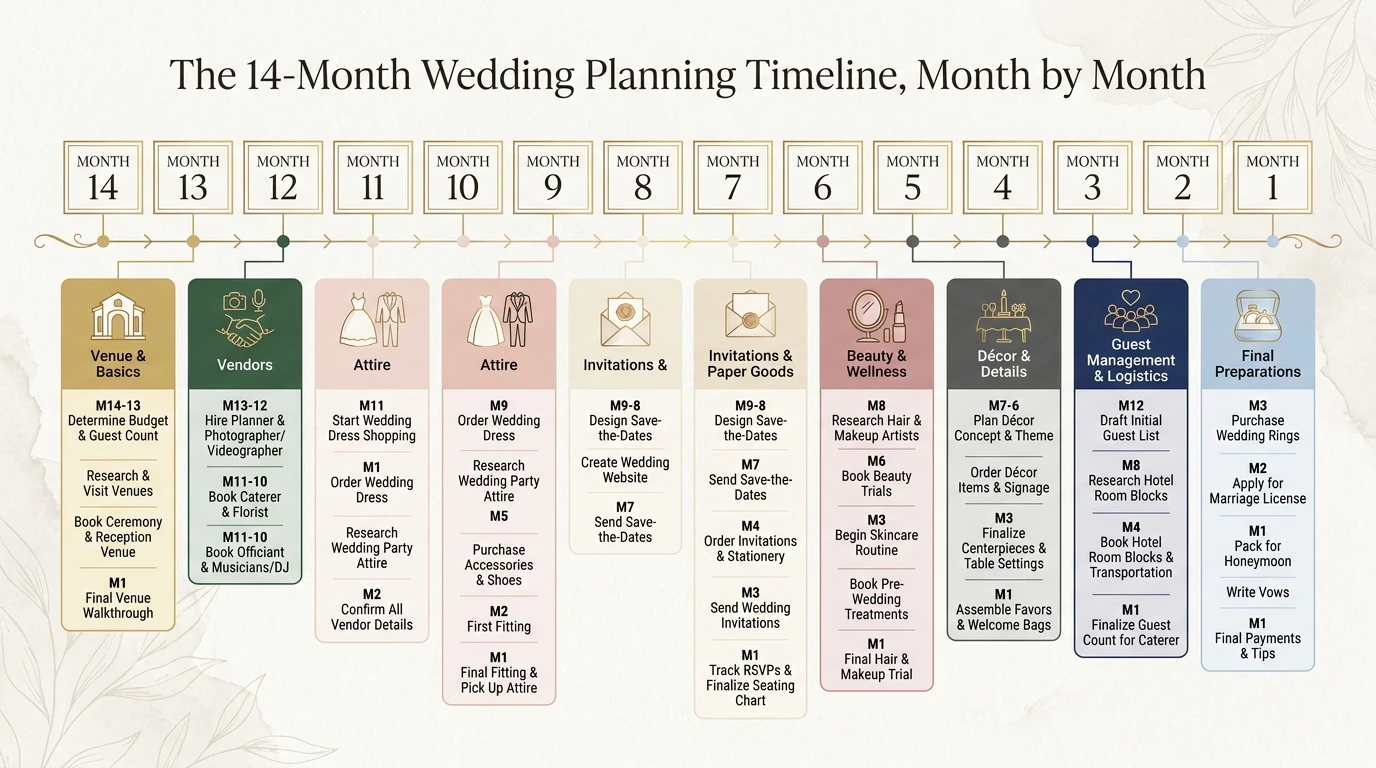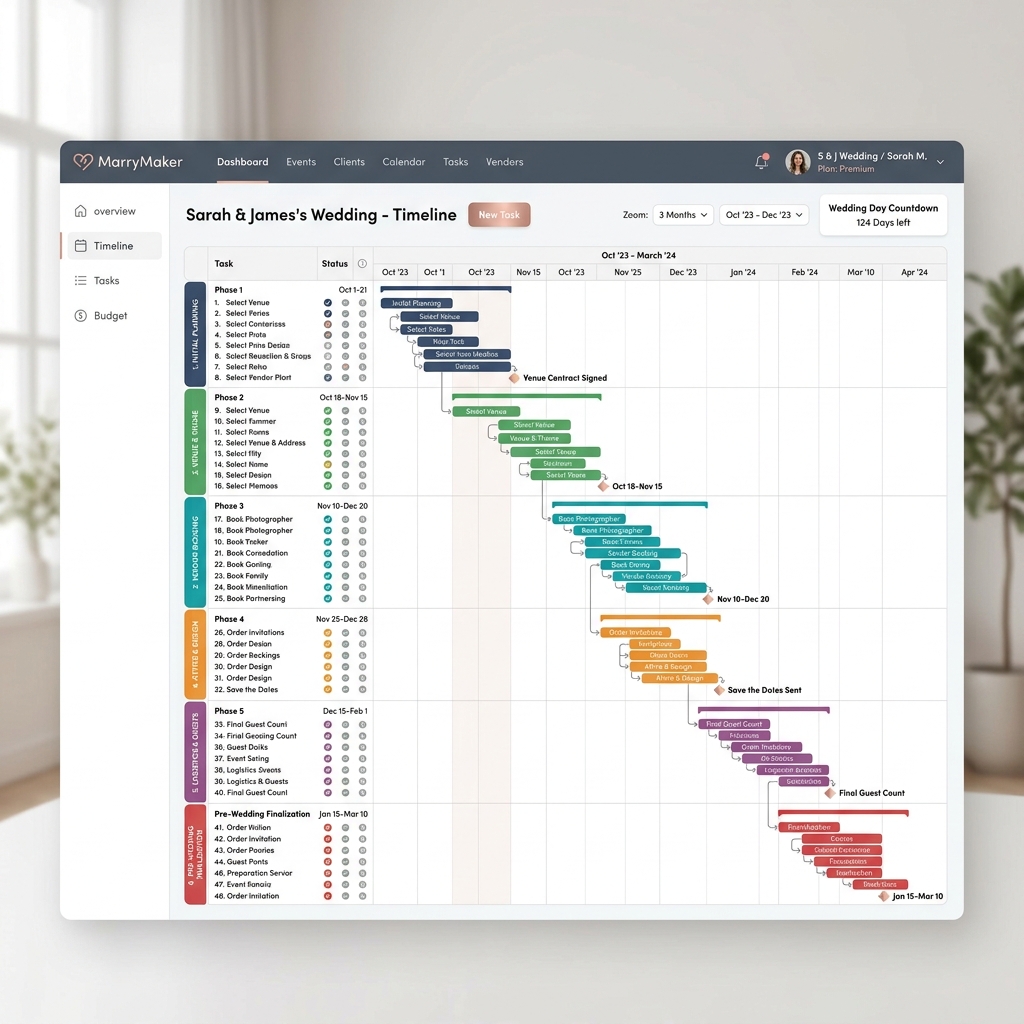
Wedding planning is a complex project spanning 12–24 months, involving 30+ vendors, 100+ decisions, and tight coordination across multiple teams. Without a clear timeline framework, chaos emerges: missed deposit deadlines, conflicting vendor schedules, client miscommunication, and last-minute crises. Professional wedding planners use strategic timelines—not just checklists—to orchestrate complexity and deliver seamless events.
This guide explores the architecture of professional wedding timelines: how to structure planning phases, prioritize decisions, coordinate vendors, manage client expectations, and build contingency buffers. Whether you are managing engagements lasting 18 months or 6 weeks, this framework scales.
“A checklist tells a couple what to buy; a timeline framework governs when and how every decision interacts with vendor logistics. Mastering sequencing is what separates amateur planning from world-class event execution.
VVictoria Sterling
Master Event Architect & Industry Educator
Why Wedding Timeline Strategy Matters: Beyond the Checklist
A wedding checklist is a flat, one-dimensional list of tasks: “Book venue”, “Order flowers”, “Send invitations”. A timeline framework is three-dimensional: it accounts for task dependencies (you cannot order flowers until you know the color palette), decision sequencing (venue choice drives budget allocation), and vendor coordination (photographer must coordinate with florist to ensure setup access).
Why does this distinction matter? Couples who follow a flat checklist complete tasks, but often in an inefficient or counterproductive order. They might book a high-end caterer before selecting the venue, only to discover later that the venue has strict mandatory in-house catering or limited kitchen facilities. This forces expensive renegotiations or lost deposits. Professional planners who implement a structured timeline framework avoid this cascade of rework.
┌────────────────────────────────────────────────────────────────────────┐
│                        FLAT CHECKLIST vs. 3D TIMELINE                  │
├────────────────────────────────────────────────────────────────────────┤
│ Flat Checklist:  Task A ──► Task B ──► Task C (No context of dependency)│
│                                                                        │
│ 3D Framework:   [Venue Selection] ──► [Guest Count & Budget Allocated] │
│                          │                       │                     │
│                          ▼                       ▼                     │
│                 [Catering Logistics] ──► [Floral & Decor Design]       │
└────────────────────────────────────────────────────────────────────────┘
A comprehensive timeline framework enables:
- Efficient Decision-Making: Decisions are made in a logical sequence where each choice informs the next.
- Vendor Coordination: Vendors are contracted and scheduled in order of operational dependency.
- Client Communication: Clear milestone notifications keep couples aligned without overwhelming them.
- Risk Management: Strategic contingency buffers absorb unexpected vendor delays or weather shifts.
- Quality Assurance: Adequate lead time is built in for sample revisions, floral mockups, and menu tastings.
To complement this framework, explore our interactive Wedding Planning Timeline Tool to map your specific milestone dates automatically.
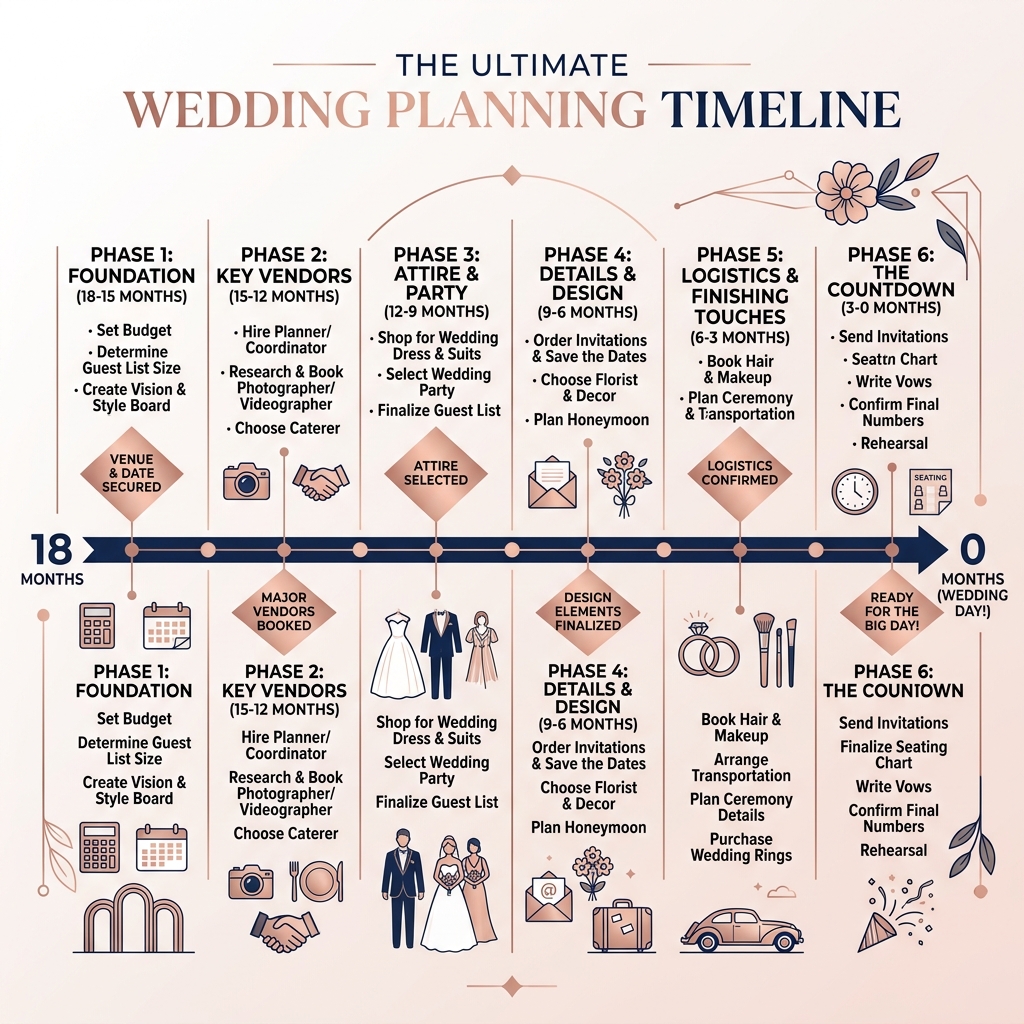
The Six Phases of Professional Wedding Timeline Planning
Professional wedding planning divides into six distinct phases, each with specific decision priorities, milestone targets, and vendor activities.
Phase 1: The Foundation (Months 18–12 Before Wedding)
Timeline decisions made during Phase 1 determine all downstream choices. This phase focuses on core fundamentals: vision, budget ceiling, venue selection, and primary anchor vendors.
Critical Tasks:
- Establish wedding vision (style, aesthetic, formal vs. casual vibe).
- Define budget ceiling (total spend, category allocations, emergency reserve).
- Research, tour, and book venue (this single decision drives all subsequent logistics).
- Secure official date hold with the venue.
- Engage a professional wedding planner if not already on board.
- Book lead photographer and videographer (high-demand visual artists book 12–18 months early).
- Perform preliminary vendor research (compile shortlists for caterer, florist, and entertainment).
Decision Dependencies: Venue selection determines guest capacity. Guest count drives food and beverage spend. Total spend dictates vendor tier allocation (luxury vs. moderate vs. budget-conscious). Vendor tier shapes the timeline—luxury vendors frequently book out over a year in advance. Learn more about selecting your dream space in our detailed guide on How to Choose a Wedding Venue.
Use our interactive Wedding Budget Calculator to allocate spend across categories accurately during Month 18. Pair this with our Wedding Budget Tips for strategic cost distribution.
Phase 2: Core Vendor Selection (Months 12–9 Before Wedding)
High-demand vendors—including custom caterers, floral designers, and live bands in competitive wedding markets—book 9–12 months prior to the event date. Phase 2 locks in this core operational team.
Critical Tasks:
- Book caterer and finalize menu concepts (schedule 2–3 tasting sessions).
- Engage floral designer and establish structural floral concepts.
- Book primary entertainment (DJ ensemble or multi-piece live band).
- Secure rental company contracts (tables, chairs, specialty linens, glassware, and staging).
- Engage officiant and confirm ceremony requirements.
- Begin custom invitation design process and paper stock selection.
- Research and reserve hotel room blocks for out-of-town guests.
Caterers operating in high-demand wedding seasons (May through October) are often fully booked by Month 9. Delaying caterer selection risks losing top choices or incurring mandatory venue surcharge penalties.
Phase 3: Design & Details (Months 9–6 Before Wedding)
With core vendors locked in, Phase 3 refines aesthetic details: exact color swatches, floral centerpiece designs, full menu pairings, music playlists, and invitation wording.
Critical Tasks:
- Finalize invitation suite design and place print order (include clear RSVP cutoff date).
- Confirm exact color palette with florist, rental house, and graphic designer.
- Approve caterer’s detailed menu selections and wine pairings.
- Book secondary vendors (hair and makeup artists, transportation fleet, photobooths).
- Outline rehearsal dinner location and itinerary.
- Begin honeymoon flight and accommodation bookings.
Client Communication Strategy: Schedule a dedicated design consultation with the couple. Present mood boards, color swatches, and physical floral mockups. Iterate on feedback and lock design specifications by the conclusion of Month 6.
Phase 4: Execution & Confirmation (Months 6–3 Before Wedding)
Major creative decisions are complete. Phase 4 transitions into execution, contract confirmation, and early logistical coordination.
Critical Tasks:
- Mail invitation suites (6–8 week lead time before the event; 10–12 weeks for destination weddings).
- Confirm all signed vendor contracts, payment schedules, and insurance certificates.
- Set strict RSVP deadline (typically 3–4 weeks prior to wedding date).
- Audit outstanding vendor balances and schedule final deposit disbursements.
- Collect preliminary guest responses and organize headcount data.
- Draft detailed day-of master timeline and share draft with primary vendors.
- Brief wedding party regarding rehearsal times, attire fittings, and roles.
Utilize our Wedding Progress Tracker to monitor RSVP tallies and vendor contract statuses in real time. Compare this against our 18-Month Wedding Planning Timeline checklist.
Phase 5: Final Confirmation (Months 3–1 Before Wedding)
RSVPs are finalized and final guest counts are locked. Phase 5 resolves emerging operational details, seating arrangements, and contingency protocols.
Critical Tasks:
- Submit final guaranteed guest count to caterer and venue (typically 7–14 days prior).
- Finalize seating chart, escort cards, and place card assignments using our Guest List Manager.
- Confirm exact arrival, setup, loading dock, and parking logistics with all vendors.
- Distribute finalized day-of master timeline to couple, wedding party, and vendor leads.
- Process dietary restriction notes and accommodate last-minute guest updates.
- Verify transportation pickup times, shuttle routing, and driver contact info.
Contingency Activation: If hosting an outdoor ceremony, review weather forecasts 10 days out and make the final call on weather tenting or indoor Plan B venue activation 72 hours prior. Ensure backup vendor contacts are on standby.
Phase 6: Final Week & Day-Of Execution
The wedding is days away. Phase 6 represents high-touch coordination, timeline enforcement, and crisis prevention.
Final Week Tasks:
- Re-confirm arrival time windows with every vendor lead.
- Confirm final vendor gratuities and balance payments are prepped in labeled envelopes.
- Conduct wedding rehearsal and brief ceremony attendants.
- Deliver personal items (champagne flutes, guestbook, place cards, favors) to venue coordinator.
- Confirm couple remains relaxed and fully informed.
Wedding Day Tasks:
- Arrive early on-site to oversee vendor load-in and setup.
- Verify floral installations, lighting rigs, and table settings match approved mockups.
- Maintain timeline discipline (monitor ceremony start, photo sessions, and reception entrances).
- Manage unexpected disruptions (late guest arrivals, weather adjustments, timing drift).
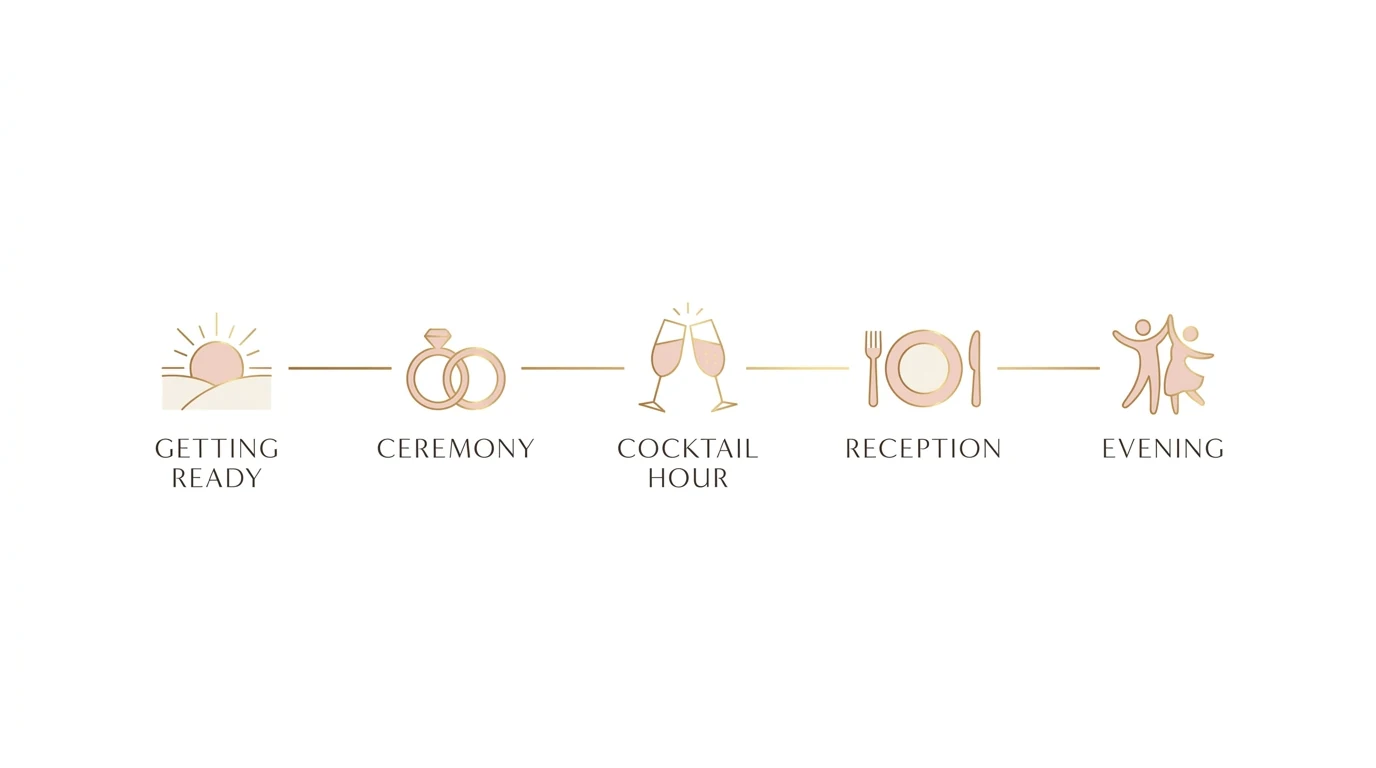
- Coordinate smooth transitions between ceremony, cocktail hour, dinner, and dancing.
- Supervise end-of-night teardown, decor packing, and vendor sign-offs.
Compressed Timelines: Planning When Time Is Limited
When engagements are short due to rapid timelines or elopement plans, compress planning phases while preserving decision sequencing.
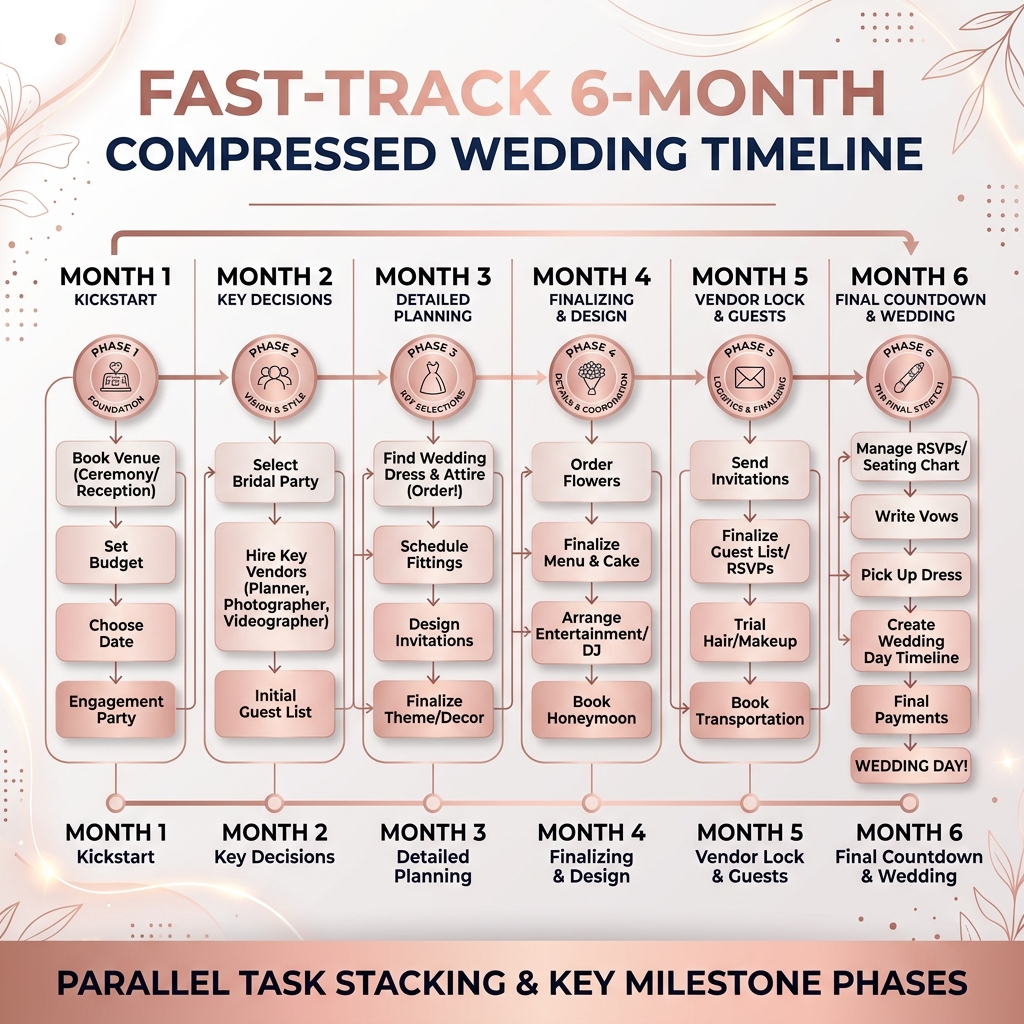
The Fast-Track 6-Month Framework
┌────────────────────────────────────────────────────────────────────────┐
│                        6-MONTH COMPRESSED TIMELINE                     │
├────────────────────────────────────────────────────────────────────────┤
│ Months 6–4:  Lock Venue, Date, Caterer, Photographer (Phases 1 + 2)    │
│ Months 4–2:  Finalize Design, Rentals, Invitations (Phases 3 + 4)      │
│ Months 2–0:  Final Counts, Seating, Day-Of Execution (Phases 5 + 6)    │
└────────────────────────────────────────────────────────────────────────┘- Months 6–4 (Foundation + Core Vendors): Lock venue, date, catering, photographer, and officiant simultaneously.
- Months 4–2 (Design + Execution): Finalize decor, order attire, mail invitations, and confirm rental orders.
- Months 2–0 (Final Confirmation + Day-Of): Lock guest counts, build seating charts, and execute day-of timeline.
The primary hazard in a 6-month timeline is vendor scarcity. Premium photographers and top venues book a year out. Solution: Tap into your planner’s preferred vendor network or leverage flexible weekday/off-peak wedding dates. Generate custom task lists with our Wedding Checklist Generator.
Vendor Coordination Sequence: The Dependency Map
Understanding vendor interdependencies prevents scheduling bottlenecks during load-in and setup. Key vendor pairs must coordinate directly:
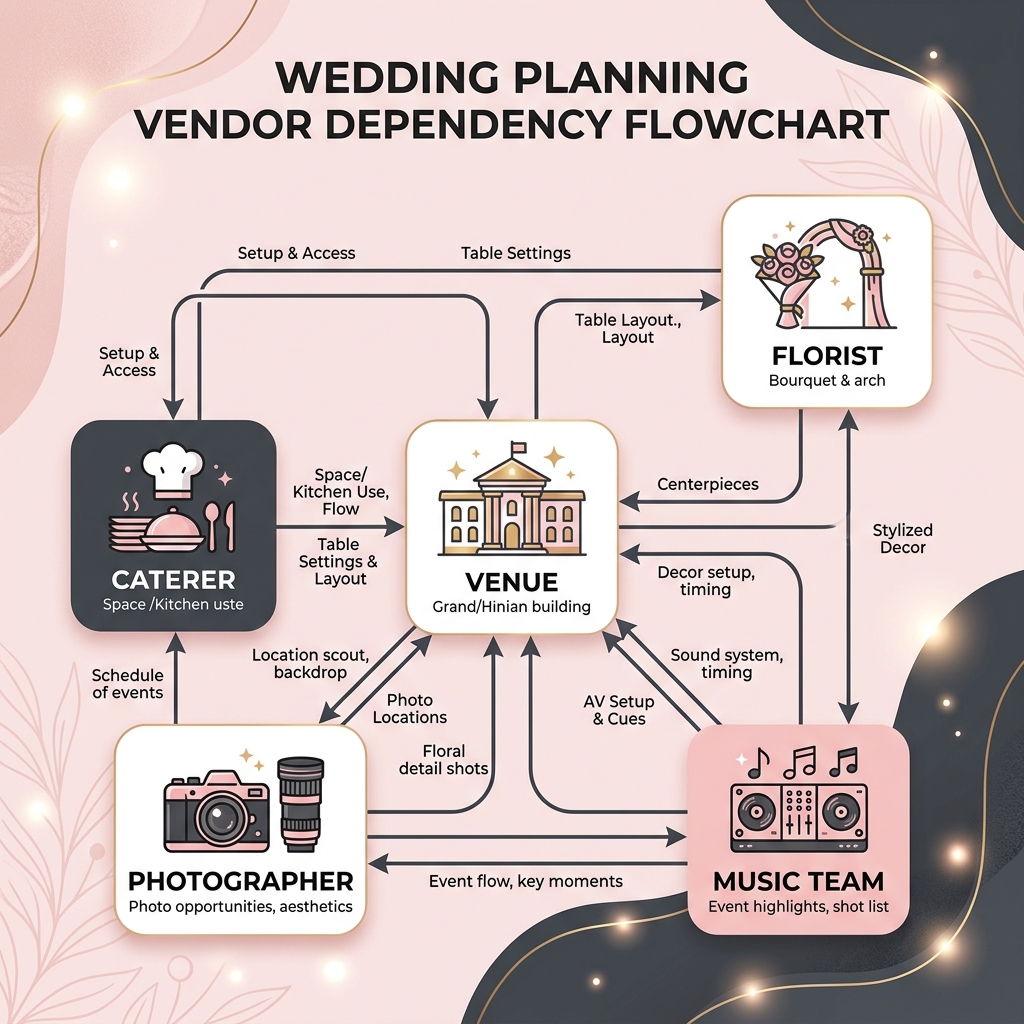
| Vendor Pair | Dependency & Coordination Requirement | Action Timing |
|---|---|---|
| Florist & Venue | Florist requires exact table dimensions, ceiling anchor points, arch constraints, and loading elevator availability. | 3 Months Before |
| Photographer & Florist | Photographer requires complete floral setup access 30 minutes before first look photos to capture pristine detail shots. | 2 Weeks Before |
| Caterer & Venue | Venue provides kitchen power, prep surfaces, and service doors; caterer confirms equipment specs match venue rules. | 2 Months Before |
| DJ/Band & Electrician/Venue | Sound team requires dedicated circuit power and decibel limit guidelines from venue management. | 1 Month Before |
Use our Interactive Timeline Generator to establish customized setup time blocks for each vendor team.
Client Communication Protocol: Keeping Couples Informed
A professional timeline incorporates structured client touchpoints to prevent overwhelm while ensuring timely decisions.
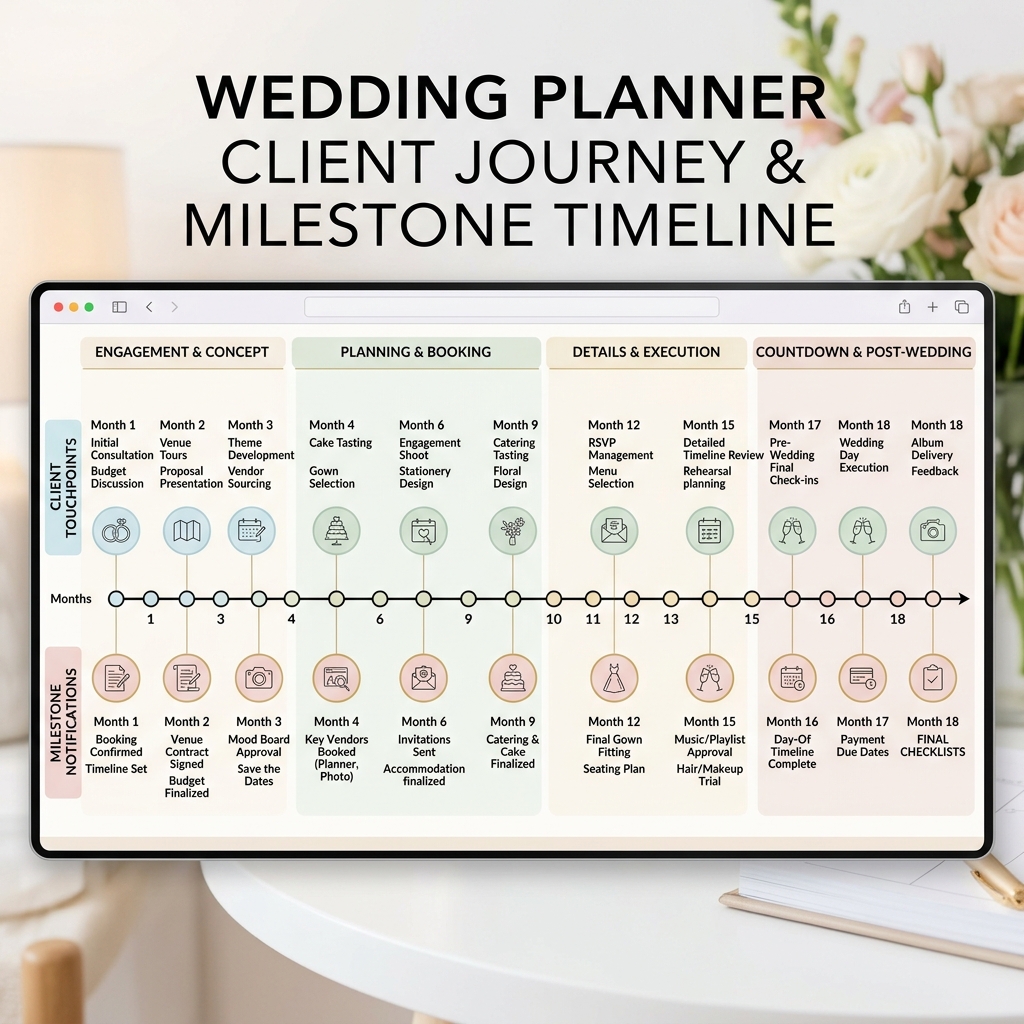
- Month 18: Engagement kickoff meeting, vision brainstorming, and overall budget review.
- Month 12: Venue walkthrough presentation, preliminary vendor proposals, and budget allocation lock.
- Month 9: Core vendor contract reviews and aesthetic mood board sign-off.
- Month 6: Invitation proofing, stationery approval, and timeline overview session.
- Month 3: Seating arrangement review, menu finalization, and RSVP tracking check-in.
- Month 1: Final walk-through, rehearsal review, and day-of timeline walk-through with couple.
Decision Matrix: What Needs to Happen and When
Use this decision priority matrix to categorize tasks and prevent critical delays.
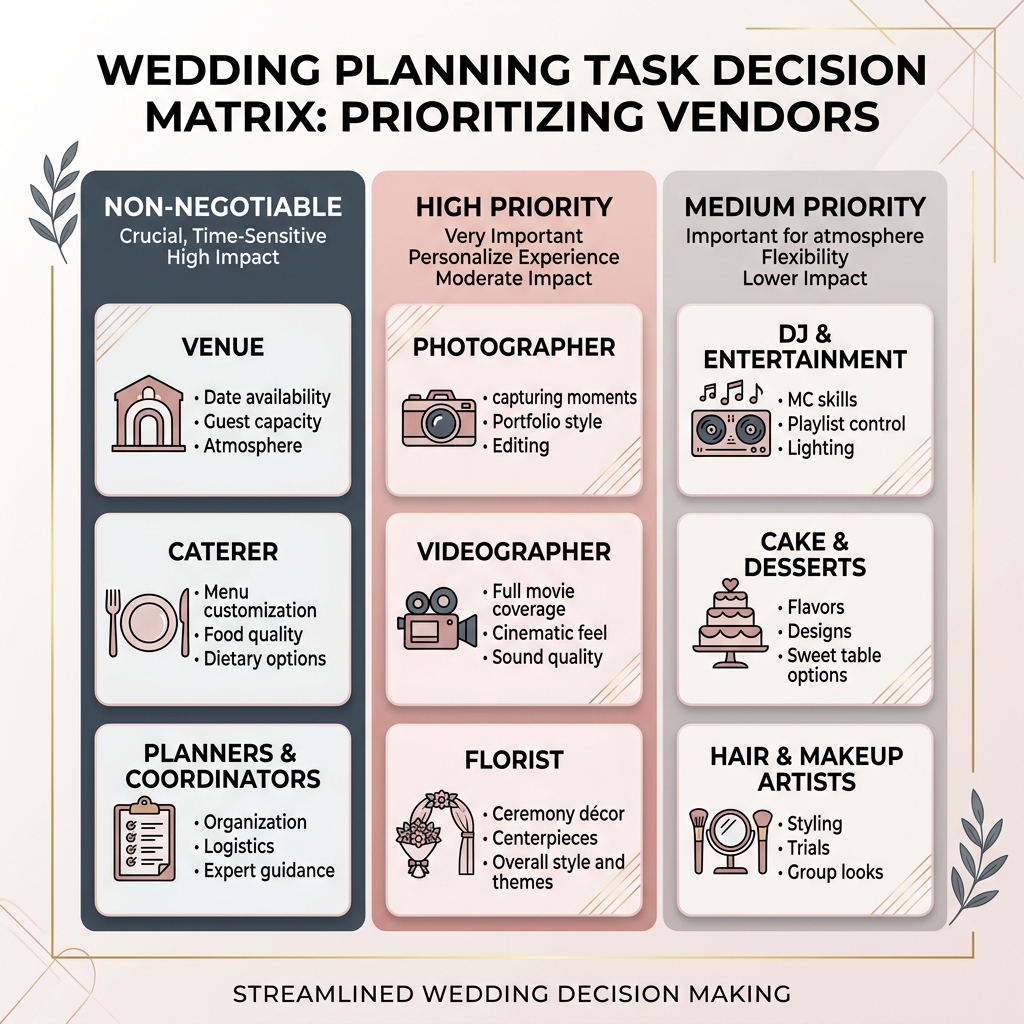
1. NON-NEGOTIABLE (Cannot Be Delayed)
- Venue Booking (Month 12-18): Establishes date, guest capacity, and geographic baseline.
- Catering Contract (Month 9-12): Locks in food and beverage budget allocation.
- Lead Photographer (Month 12): Secures preferred visual documentation team.
- Invitation Mailing (Month 6): Guarantees guests receive adequate notice for travel.
2. HIGH-PRIORITY (Should Not Slip)
- Floral Designer (Month 9): Requires design concept iterations.
- Entertainment Team (Month 9): High-demand live bands book early.
- Rental Orders (Month 6): Specialty chairs, tableware, and lighting require lead time.
3. MEDIUM-PRIORITY (Can Slip 2–4 Weeks)
- Hair & Makeup Artists (Month 4): Trial sessions can be scheduled closer to event.
- Wedding Favors & Signage (Month 3): Secondary decor elements.
- Ceremony Programs (Month 1): Printed after ceremony sequence is finalized.
Common Timeline Mistakes: What Professional Planners Avoid
Couples often book a photographer, then rental items, and finally a venue. Smart planners always secure the venue first—because venue rules, dimensions, and catering policies dictate every subsequent contract.
Building a day-of schedule with zero buffer creates chaotic delays when hair and makeup run 15 minutes late. Professional planners insert 10–15% buffer time before major transitions (e.g., guest arrival starts 30 minutes before ceremony).
Allowing vendors to arrive whenever they choose causes loading dock congestion and photo disruptions. Solution: Issue a master day-of load-in schedule 2 weeks prior, designating exact arrival windows for florist, rentals, caterer, and band.
Strategic Planning Conclusion & Next Steps
Wedding timeline planning is not just scheduling—it is strategic orchestration. Professional planners recognize that timing, sequencing, and coordination are the three pillars supporting successful events. A well-structured timeline prevents chaos, optimizes vendor partnerships, clarifies client communication, and ensures nothing falls through the cracks.
Ready to build your personalized wedding planning framework? Explore our free interactive planning tools:
- Interactive Timeline Generator: Generate customized milestone schedules based on your wedding date.
- Wedding Budget Calculator: Plan your category spend according to your timeline phase gates.
- Guest List Manager: Organize RSVPs, seating charts, and dietary requirements effortlessly.
- Wedding Checklist Generator: Create tailored task lists matching your exact timeline phase.