Indian wedding hairstyles work best when they match the function, the outfit and the shape of your face. This complete guide covers simple Indian wedding hairstyles, Indian wedding hairstyles for long hair, medium hair and short hair, plus modern Indian wedding hairstyles for long hair, bridal hairstyle front views, hairstyles for Indian wedding guests and Indian wedding hairstyles for men. You’ll find picks for Haldi, Mehendi, Sangeet, the ceremony and the reception, a face shape table, accessory advice, and a hair trial schedule you can track with the Wedding Countdown tool. Use it to plan each look before you book your stylist.
What Are Indian Wedding Hairstyles?
Indian wedding hairstyles are the buns, braids, updos and open-hair looks worn across the several events of an Indian wedding. They are not one style. A Tamil bride’s long braid threaded with jasmine and a Punjabi bride’s low bun under a dupatta look nothing alike, yet both treat hair as part of the bridal ornament.
What sets them apart from western bridal hair is the load. Your hair has to hold up a dupatta, a maang tikka, sometimes a matha patti, and fresh flowers, and it has to survive rituals that run for hours. So most good Indian wedding hairstyles start with structure and finish with decoration, not the other way around.
This guide sorts the options three ways: by wedding function, by face shape and by hair length. It then covers the searches couples keep making, from simple styles to looks for guests and grooms.
How to Choose Your Indian Wedding Hairstyle
Work through these in order. Each one narrows the list for the next.
- Function. A Mehendi look and a pheras look have different jobs. One needs to be easy, the other needs to hold.
- Outfit weight. A heavy lehenga with a bridal dupatta needs a stronger base than an indo-western gown.
- Jewelry and dupatta. Know where the tikka sits and where the dupatta will be pinned before you pick a bun position.
- Face shape. Use it to fine-tune height, width and parting, not to rule styles out.
- Hair length and texture. Thin hair may need clip-in volume. Very thick hair may need fewer products and more pins.
- Hours and weather. An outdoor ceremony in a hot month needs a style that won’t sag.
If your outfits aren’t settled yet, start with our guide to wedding outfits for brides. The neckline and dupatta decide half of your hair choices. If you’re planning the whole celebration, the Indian wedding checklist shows where hair and makeup bookings fit among the other tasks.
Indian Wedding Hairstyles by Function
Most Indian weddings run over several days, and each event asks something different from your Indian wedding hairstyles. Plan each look separately, even if the same stylist does all of them.
Haldi and Mehendi Hairstyles
Haldi and Mehendi are the relaxed events, but they’re also the messy ones. Turmeric, petals and henna all end up near your hair, so pick something you won’t mind washing out that night. Loose floral braids, a side braid with marigolds, soft side-swept curls or a half-up style with baby’s breath all work. A little oil on the ends beforehand tends to make turmeric wash out more easily.
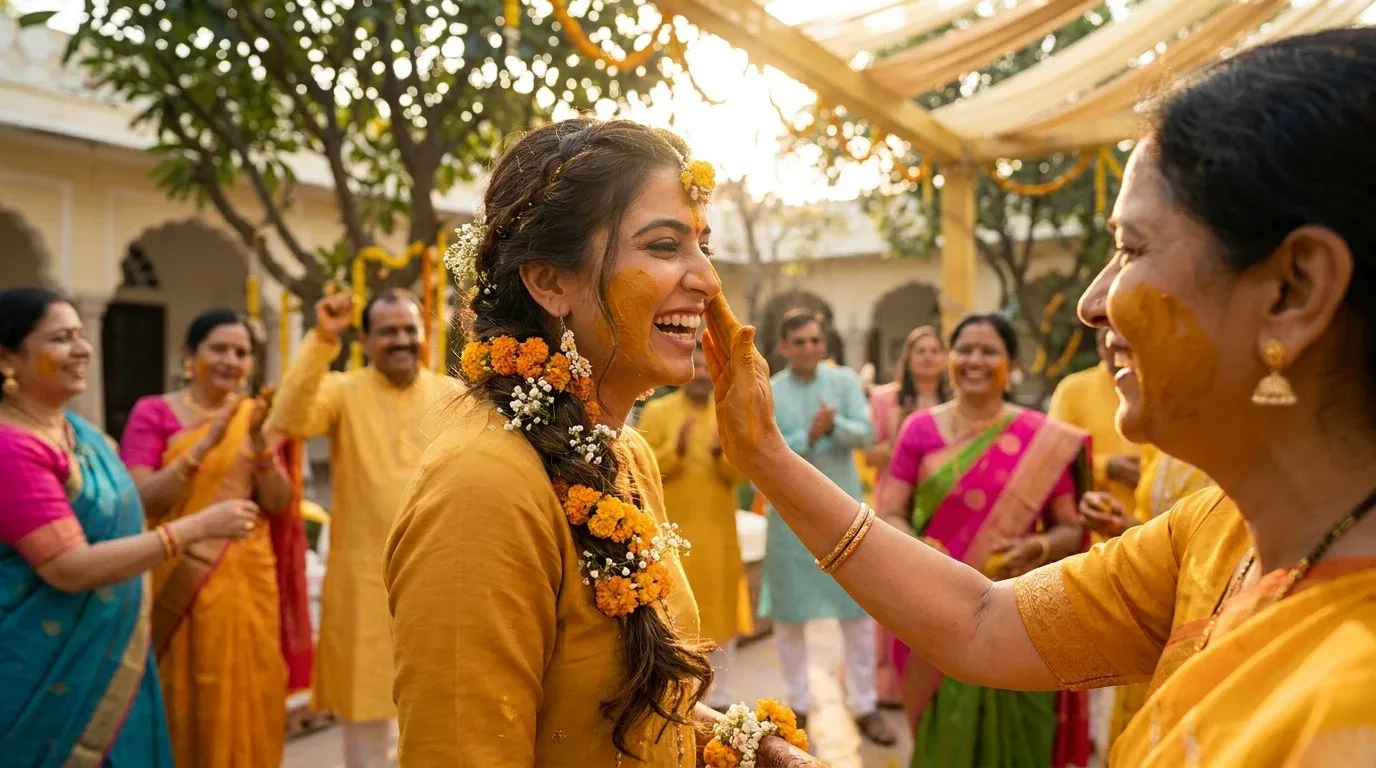
Mehendi has one extra rule. Once your hands are covered in wet henna, you can’t fix anything. Choose a style that stays where you put it for the whole session. A braid or a twisted half-up is safer than loose waves you’ll keep wanting to tuck back. Deep condition about 48 hours before, because henna can leave hair dry.
Sangeet Night Hairstyles
Sangeet is the dance night, so the hair needs movement and volume that survives spinning. Open Hollywood waves, a textured fishtail braid, a half-up style with a braided crown, a high ponytail with lift at the crown, or a deliberately messy bun all hold up on a dance floor. Pins and hairspray matter more than the shape itself.
If you’re performing choreography, rehearse in the real shoes and with the hairstyle. You’ll find out fast whether the waves stay or the ponytail swings into your face.
Main Wedding Ceremony Hairstyles
The ceremony is where structure matters most. You’ll sit, stand, walk around the fire, bend for blessings and keep a heavy dupatta on your head for hours. The classic answer is a low judas (low bun) built over a padded donut, pinned into the base and wrapped with fresh gajra.
Low placement matters because the dupatta is usually pinned at the crown. A high bun fights it. Decide your parting early too, since a maang tikka or matha patti sits right along it. For South Indian ceremonies, a long braid with temple jewelry and jasmine is the traditional choice, and our guide to regional Indian wedding hairstyles covers the differences state by state.
Reception Night Hairstyles
The reception is the one night you can move from traditional to polished and modern. A sleek high bun, a low ponytail with a middle parting, side-swept glam curls or a twisted chignon all suit a gown or a lighter lehenga. If the outfit has a low back or you’re wearing statement earrings, keep the hair up and off the neck so the jewelry shows.
Quick Comparison by Function
| Function | Best style | Why it works | Watch out for |
|---|---|---|---|
| Haldi | Loose floral braid, half-up with flowers | Easy to wash out, relaxed | Turmeric staining |
| Mehendi | Braid, twisted half-up | Holds without touch-ups | Dry hair from henna |
| Sangeet | Hollywood waves, fishtail, high ponytail | Survives dancing | Style collapsing mid-night |
| Wedding ceremony | Low judas with gajra, long braid with jewelry | Anchors dupatta and ornaments | Bun placed too high |
| Reception | Sleek high bun, glam curls, chignon | Shows jewelry and neckline | Over-styling that clashes with the outfit |
30+ Indian Bridal Hairstyles by Type
Use this list as a menu, not a rulebook. Each of these Indian wedding hairstyles for brides is grouped by type so you can compare options that behave alike, then shortlist three or four to test at your trial.
Bun and Judas Bridal Hairstyles
Buns give the strongest base for a dupatta, tikka and flowers, which is why they dominate Indian wedding hairstyles for the ceremony. Pick the position by outfit weight and face shape.
- Low Judas with Gajra. A low bun built over a padded donut and wrapped in fresh jasmine. It anchors a heavy dupatta and matha patti, and it stays secure through hours of rituals. Best for long ceremonies.
- Rose Ring Bun. A low bun circled with a ring of red or pink roses. It reads as classic and festive, and it photographs well from the back when your dupatta is lifted.
- Side Bun. A low bun pinned to one side of the nape, often with a few loose face-framing strands. It softens a strong jaw and suits lighter dupattas and reception lehengas. Ask for firm pinning.
- High Bun with Jeweled Pins. A sleek bun set at the crown and studded with small jeweled pins. It adds height for round faces, but it needs a lighter dupatta that sits behind it. Test it with your outfit.
- Messy Low Bun. A relaxed low bun with loose tendrils left at the temples. It looks effortless, works for Mehendi or a day ceremony, and takes less time to set than a polished knot.
- Twisted Chignon. Hair twisted into a rolled knot at the nape and pinned flat. It stays neat under a veil or dupatta, and it suits medium hair that is too short for a full braid.
- Layered Bun with Flowers. Two stacked buns, one at the crown and one below, decorated with marigolds or orchids. It creates dramatic volume for Sangeet photographs, though it sits too high for a dupatta.
- Bun with Maang Tikka and Matha Patti. A low, smooth bun left clean at the front so the forehead jewelry takes center stage. The chain is pinned into the parting, so the base must be firm. Keep the parting straight.
Braid Bridal Hairstyles
Braids are the traditional answer for South Indian and many regional weddings, and these Indian wedding hairstyles now appear in modern looks too. They hold well and carry flowers beautifully.
- Jadai Long Braid. A long, tightly woven braid layered with temple jewelry and jasmine. It is the signature South Indian bridal look, and the jewelry follows the braid from crown to tip. It suits very long hair.
- Fishtail Braid. A narrow, textured braid pulled loosely over one shoulder. It photographs well, suits Sangeet and receptions, and holds its shape through dancing without needing heavy product. Tuck small flowers along the weave for a festive finish.
- French Braid into a Bun. A French braid that starts at the crown and finishes in a low bun. It keeps hair secure and gives a tidy front view under a dupatta or tikka. Good for medium hair too.
- Dutch Braid Crown. A raised braid worn like a headband from ear to ear. It frames the face, keeps hair off the forehead, and leaves the lengths free for waves or a low bun.
- Side Braid with Flowers. A loose braid worn to one side with marigolds, roses or baby’s breath woven in. It is easy to wear for Haldi and Mehendi, and it forgives a little frizz.
- Four-Strand Braid. A flat, rounded braid that looks more detailed than a plain three-strand plait. It works for both traditional and indo-western outfits, and it adds texture to thinner hair. Stylists often add flowers at the base.
- Braided Low Bun. A braid wrapped around itself into a low bun. It combines the neatness of a plait with the strength of a bun, so a heavy dupatta sits comfortably on top.

Open Hair and Curl Bridal Hairstyles
Open Indian wedding hairstyles suit receptions, engagement parties and lighter outfits. They show off long layers, but they rarely hold a heavy dupatta, so choose them with that in mind.
- Hollywood Waves. Brushed-out, glossy waves parted deeply to one side. They suit Sangeet and receptions, and a single jeweled clip at the parting adds an Indian touch without weighing the hair down.
- Soft Open Curls. Loose curls set with a medium barrel and left to fall naturally. They add romance to a reception gown, though they need strong hairspray to last into the late evening.
- Sleek Straight Hair. Pin-straight hair with a center parting and a high shine. It is minimal and modern, and it lets heavy earrings, necklaces and a maang tikka do the talking. Smooth the flyaways before photos.
- Side-Swept Curls. Curls pinned behind one ear and cascading over the opposite shoulder. This shows off statement earrings, flatters round and square faces, and works well for evening photographs. Use a few hidden pins.
- Voluminous Blowout. A bouncy, full-bodied blowout with soft ends. It makes thin hair look fuller and suits receptions, but it should be sprayed well so it doesn’t flatten before the vows. Clip-in extensions can add fullness.
- Beach Waves with Floral Pins. Loose, tousled waves with tiny flowers pinned throughout. A relaxed choice for daytime functions, outdoor ceremonies and destination weddings, where humidity might wreck a sleeker finish. Choose sturdy blooms like baby’s breath, pinned close.
Half-Up and Crown Bridal Hairstyles
Half-up Indian wedding hairstyles balance structure and movement. They keep hair off the face while showing length, and they sit well with lighter dupattas and indo-western outfits.
- Half-Up with Jeweled Clip. The top section pulled back and fixed with an embellished clip, with the rest left in waves. It is quick, photogenic and good for Mehendi, Sangeet and engagement functions. Choose a clip that matches your jewelry.
- Half-Up Twist. Two front sections twisted back and pinned together at the crown. It keeps strands away from your face and leaves a clean base for a short veil or lightweight dupatta.
- Half-Up with Braided Crown. A thin braid worn across the head like a halo, with the lengths left open. It frames the face softly and works especially well for Sangeet. Pin the braid ends under the top section to hide them.
- Half-Up Puff. A small lifted section at the crown, pinned in place, with the remaining hair down. It adds height for round faces and gives a dupatta a stable perch. Backcomb lightly for lift.
- Floral Half-Up. A half-up style with a line of fresh flowers pinned along the back section. It suits Haldi, Mehendi and summer weddings, and the flowers can be swapped for sprays on the day.
Ponytail and Sleek Bridal Hairstyles
Sleek Indian wedding hairstyles suit receptions and brides who prefer a polished look. They show every jewelry detail, so the parting and hairline need to be clean.
- Low Sleek Ponytail. A smooth ponytail tied at the nape and wrapped with a section of its own hair. It is sharp and modern, and the tikka sits neatly at a center parting.
- High Ponytail with Lift. A tall ponytail with volume at the crown. It elongates round faces, suits Sangeet choreography, and can be curled at the ends for extra movement during dancing. Secure it with a strong elastic.
- Braided Ponytail. A ponytail finished with a long braid down the back. It mixes sporty energy with tradition, works for engagement parties, and adds visible length when hair is shorter. Pin the braid to avoid swinging.
- Wrapped Ponytail with Gajra. A low ponytail wrapped in a jasmine strand and tied into the base. It is a simple traditional option for brides who want flowers without a full bun. Ask for a wide, firm elastic.
Traditional and Regional Bridal Hairstyles
These Indian wedding hairstyles come from specific regional traditions and carry symbolic meaning. Ask your stylist how they are secured, since many rely on real flowers and long, even lengths.
- Maharashtrian Ambada. A high, rounded bun set at the back of the head and decorated with flowers. It is the signature Maharashtrian bridal look, and it pairs with a nath and a nine-yard saree.
- Bengali Khopa. A wide, soft bun with a decorative frame of flowers, often worn with a mukut headpiece. It is closely linked to Bengali brides and sits comfortably under the topor. Keep the flowers fresh until the ceremony.
- Punjabi Low Bun with Dupatta. A neat low bun under a heavy red dupatta, usually with a center parting and tikka. It is practical, structured and common at Punjabi weddings. Pin the dupatta into the base, not loose hair.
- Gujarati Braided Bun. A braid wound into a bun and adorned with gajra and decorative pins. It pairs with the Gujarati panetar saree and holds the dupatta or pallu securely. Practice the placement with your saree.
- Kerala Jasmine Braid. A long braid or bun covered in strands of white jasmine, worn with a kasavu saree. It is simple, graceful and light, and the jasmine provides its scent. Add the strands just before the ceremony.
Indian Wedding Hairstyles by Face Shape
Face shape guidance is a styling convention, not a rule. Use it to adjust height, width and parting, then let your stylist test it on you. To find your shape, pull your hair back and compare the width of your forehead, cheekbones and jaw in a mirror.
| Face shape | Styles that tend to flatter | Placement tip | Go easy on |
|---|---|---|---|
| Round | High bun, braided crown, side-swept curls | Add height at the crown, keep the sides slim | Flat styles with volume at the cheeks |
| Oval | Nearly anything: low judas, waves, braids | Choose by outfit and function | Nothing in particular |
| Square | Soft waves, side-swept styles, low bun with loose tendrils | Soften the jaw with loose pieces at the sides | Tight, slicked-back looks that sharpen the jaw |
| Heart | Low bun, side parting, waves that fall near the jaw | Put volume at jaw level to balance a narrow chin | Very tall, tight updos |
| Long | Side waves, braids over the shoulder, low chignon | Add width, not height | Tall buns and sleek center partings |
| Diamond | Low bun, side-swept bangs, face-framing layers | Add fullness at the forehead and jaw | Flat sides that emphasize the cheekbones |
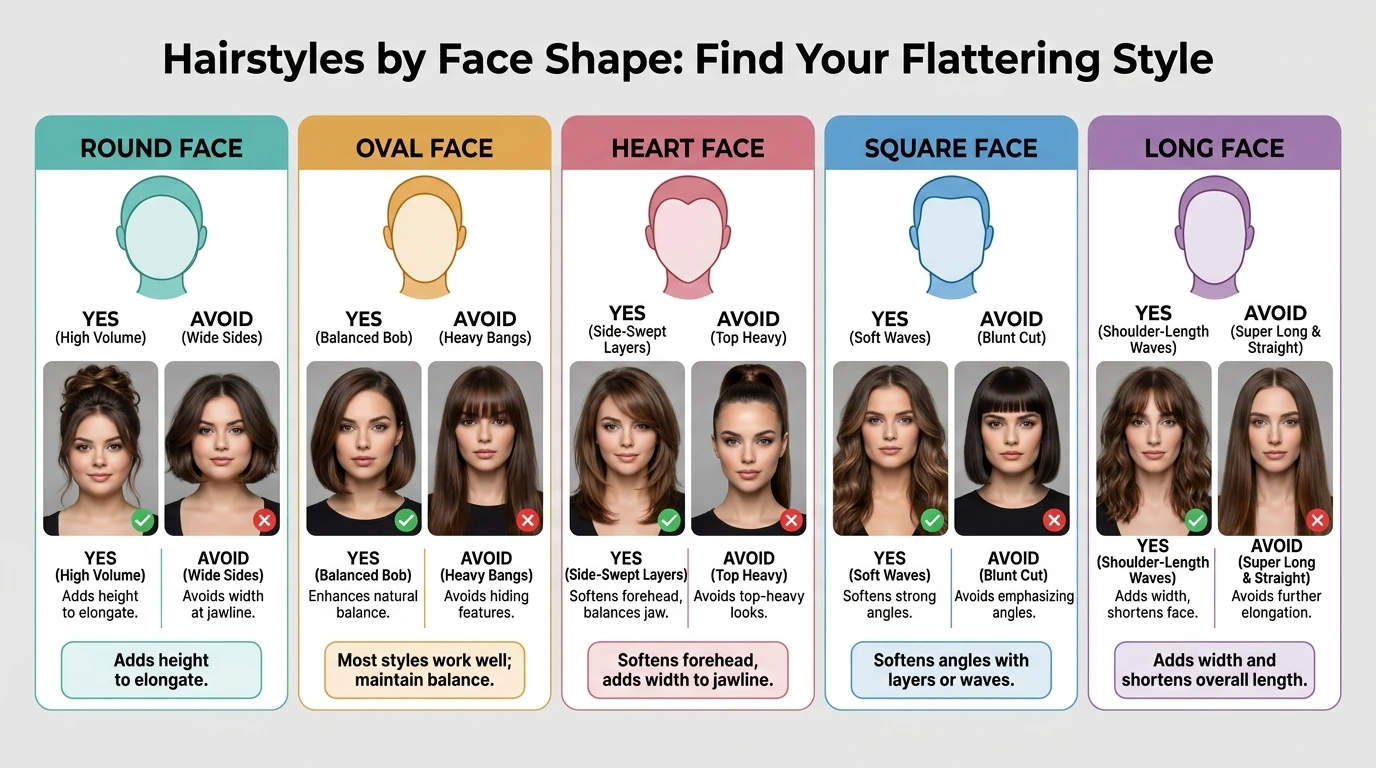
A stylist will also look at hairline, forehead height and the jewelry you’re wearing. If you want to see ideas side by side, a wedding moodboard is a good way to collect photos that show your face shape in different styles.
Indian Wedding Hairstyles for Long Hair
Long hair gives you the widest range, but it’s also heavy, so the base matters. Secure it with a strong elastic first, then build the shape and add pins.
- Low judas with gajra. The traditional anchor for a ceremony with a dupatta.
- Long braid with flowers. A classic for South Indian and many regional looks, with the braid set over one shoulder or down the back.
- Fishtail braid. Textured and photogenic, and a good fit for Sangeet.
- Soft open curls. Better for the reception than the ceremony, because they won’t hold a dupatta well.
- Half-up with a braid. Keeps hair off the face while leaving length visible.
If your hair is thin or doesn’t reach the length you want, human-hair extensions can add fullness. Have your stylist blend and texturize them at the trial so the join doesn’t show.
Indian Wedding Hairstyles for Medium Hair
Medium hair is easier to manage than long hair and still has enough length for most traditional Indian wedding hairstyles. A padded low bun, a twisted low chignon and a half-up style with soft curls are the usual picks.
A side-swept wave pinned with an embellished clip works well for Sangeet and receptions. For a braided look, clip-in extensions can add the missing length. Ask your stylist how the bun will be secured, since shoulder-length hair has less to grip.
Indian Wedding Hairstyles for Short Hair
Indian wedding hairstyles for short hair can still carry a bridal look. The trick is to add structure rather than fight the length.
- Clip-in bun. A faux bun attached at the nape or crown gives you a traditional shape.
- Pinned curls. Tight curls held with jeweled hairpins read as intentional and festive.
- Sleek bob with a clip. A polished bob with one statement clip suits a reception.
- Half-up puff. A small lifted section at the crown adds height for a dupatta to sit on.
With short hair, ask how your maang tikka or matha patti will stay in place. A stylist can pin the chain at the sides, or you can choose a lighter piece. Test this at the trial, not on the day.
Simple Indian Wedding Hairstyles
Simple Indian wedding hairstyles suit brides who want less fuss, bridesmaids, sisters of the couple and anyone doing their own hair. Simple doesn’t mean plain. One good accessory does a lot of work.
- A low side braid with a line of flowers
- A low bun with a single gajra
- A half-up twist secured with two jeweled clips
- Loose waves with one decorative pin
For simple wedding hairstyles for long hair, try a low ponytail wrapped with a section of its own hair, or a twisted-back low bun with face-framing strands left out. If you’re doing it yourself, practice at least twice before the event, cross your bobby pins in an X for grip, and finish with hairspray.
Modern Indian Wedding Hairstyles for Long Hair
Modern doesn’t mean dropping tradition. A tikka or a touch of gajra still looks right with a contemporary shape.
- Sleek low ponytail with a center parting. Clean and sharp, and the tikka sits neatly at the parting.
- Side-swept curls over one shoulder. Soft and romantic for a reception.
- Braided crown with open waves. Gives you structure up top and movement below.
- Messy low bun with loose tendrils. Relaxed but still secure.
- Glossy straight hair with jeweled clips. Minimal, and the accessories do the talking.
Bridal Hairstyle Front: What the Camera and Your Guests See
Most guests and most photographers see you from the front, so the front of the hairstyle deserves its own decisions. These are the details that change the view.
- Parting. A center parting pairs naturally with a maang tikka, since the pendant rests along it. If you prefer a side parting, plan a side-set ornament or move the tikka to match.
- Hairline framing. You can leave a few loose face-framing strands, or pin everything back for a smooth, formal finish. Loose strands soften a strong jawline. Smooth styles show off a matha patti.
- Crown height. A slight lift at the crown adds height and gives the dupatta something to sit on. Too much lift makes the dupatta slide.
- Dupatta edge. The border frames your forehead in front-view photos. Make sure the hair showing above it is neat.
At your trial, take photos from the front, side, three-quarter angle and back, in natural light.
Hairstyles for Indian Wedding Guests
Guests don’t need the full bridal build, but the hair still has to last through hours of sitting, eating and dancing. Good options include a low chignon, a side braid wrapped into a bun, soft waves with a decorative clip, or a half-up twist.
If you’re wearing a saree, keep big accessories away from the shoulder where the pallu is pinned. Pick something that won’t snag. For a dupatta, choose a style that gives it a stable place to sit. Leave the thick gajra-wrapped bun to the bride.
Indian Wedding Hairstyles for Men
Indian wedding hairstyles for men give grooms and male guests more choices than people expect. A neat side parting with a bit of texture, a slick-back, a short crop or a fade all photograph well. Men who keep longer hair often tie it back in a tidy low knot.
If a turban is part of the look, the haircut has to work with it. Rajasthani safa, Maharashtrian pheta and the Sikh dastar each sit differently, and Sikh grooms who keep uncut hair typically tie it neatly beneath the turban. Get the haircut a week or two before, and try the turban on with a professional tying it. Trim your beard a few days before so the skin has time to settle.
Accessories That Change the Hairstyle
Accessories are part of the hairstyle, so plan them together.
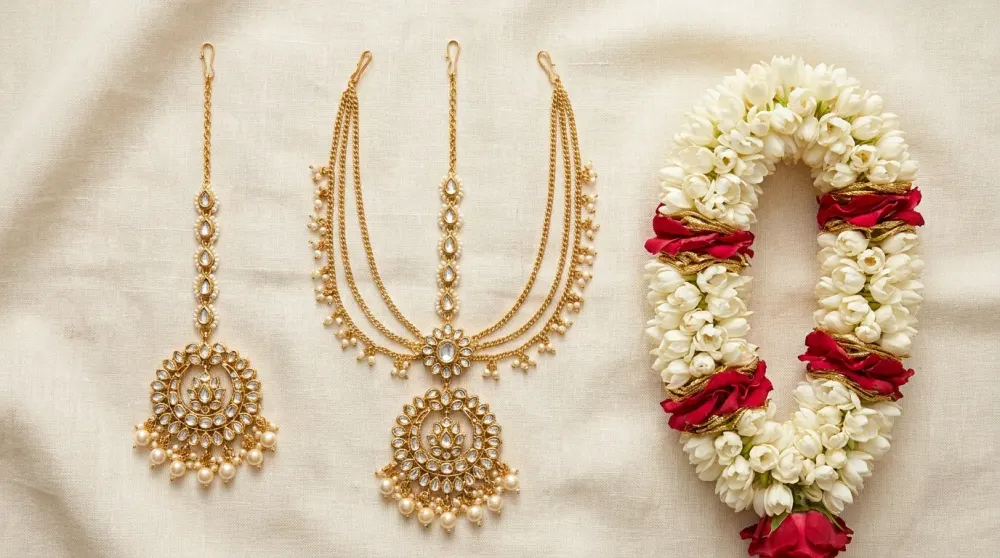
- Gajra: Fresh jasmine garlands, usually wrapped around a bun or laid along a braid.
- Maang tikka and matha patti: These sit at the parting and forehead, so the parting and hairline have to be right first.
- Fresh flowers: Jasmine, roses, baby’s breath, orchids and carnations hold up well through long rituals. Add them last, because heat wilts them.
- Jeweled pins and clips: Good for Sangeet, receptions and guest looks.
- Dupatta pins: Pin the dupatta into the base structure, not into loose hair, so it doesn’t pull.
Your Hair Trial and Timeline
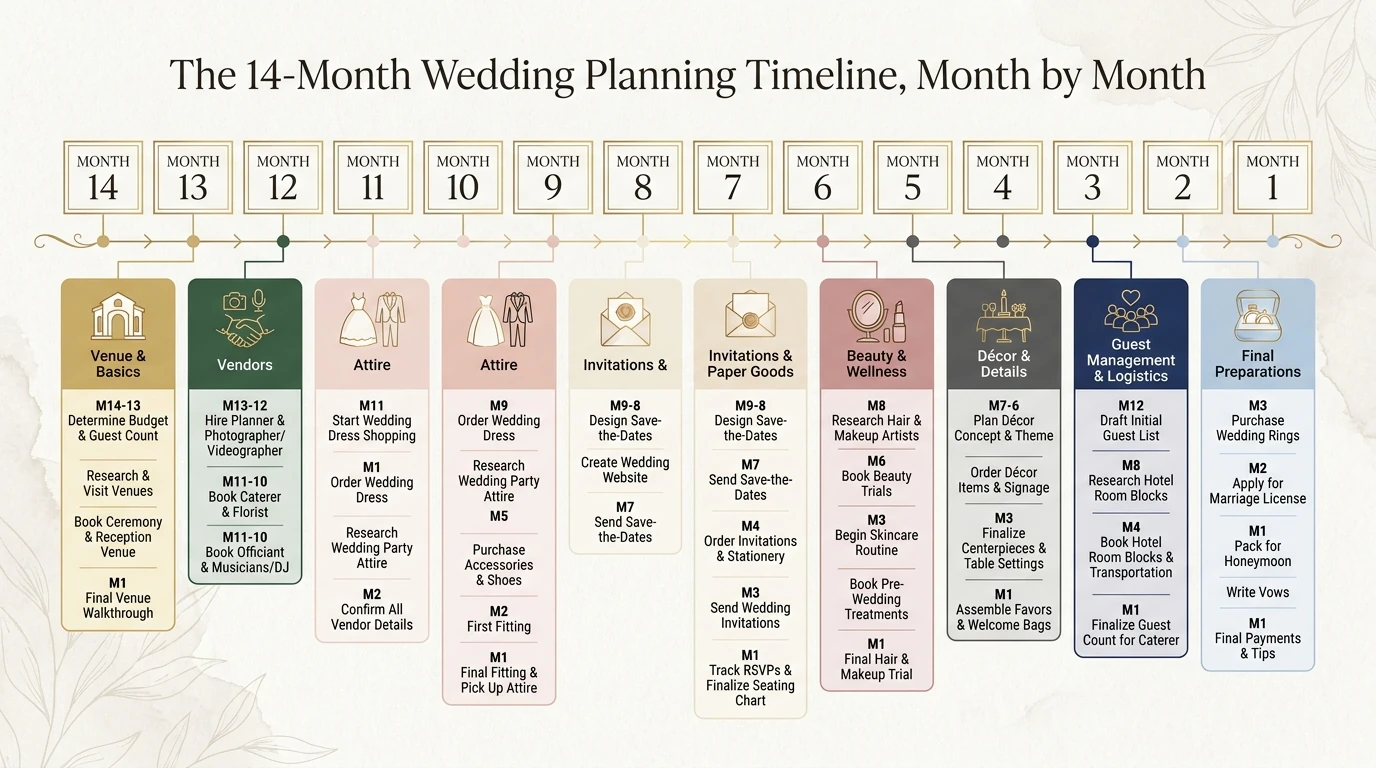
A trial turns a Pinterest photo of Indian wedding hairstyles into a real test. Bring your blouse or top, jewelry, tikka and dupatta, and sit in the style for a couple of hours to see how it holds. Our wedding guidance is to book a bridal hair stylist 6 to 9 months ahead, especially from October through February, and to hold the trial 60 to 90 days before the wedding. Our vendor booking checklist shows where a stylist fits in the booking order.
The Wedding Countdown makes those windows concrete. Enter your wedding date and work backward from the days remaining. Say your wedding is Saturday, 13 February 2027. A trial 90 to 60 days out falls between 15 November and 15 December 2026.
For the bigger picture, the wedding planning timeline shows where hair fits among every other task, and the wedding planning dashboard keeps trial dates and stylist details in one place. Don’t forget to set a line in your wedding budget calculator for hair, trials and touch-ups.
Hair Care Before the Wedding
Healthy hair makes every one of these Indian wedding hairstyles easier to build and hold. A few habits help.
- Deep condition about 48 hours before Mehendi.
- Wash with a clarifying shampoo the evening before the ceremony. Second-day hair holds curls and updos better than freshly washed hair.
- Avoid new products and big color changes in the last few weeks.
- Keep heat styling light as the wedding gets closer.
Common Mistakes to Avoid
These are the slips that most often wreck Indian wedding hairstyles on the day.
- Choosing the hairstyle before the outfit. The dupatta and neckline come first.
- Skipping the trial. Photos don’t show how a bun holds after three hours.
- Placing the bun too high. It fights the dupatta.
- Attaching flowers too early. They wilt before the ceremony starts.
- Testing in poor light. Check the look in daylight as well as indoors.
- Having no touch-up plan. Pack pins, a comb and hairspray with your bridal emergency kit.
For more ideas across styles, see our overview of best hairstyles for wedding. If you’re also planning a Pakistani celebration, our guide to Pakistani wedding hairstyles covers the Mehndi, Baraat, Nikkah and Walima looks.
Plan Your Indian Wedding Hairstyles With Confidence
The best Indian wedding hairstyles come from a short list of decisions: function, outfit, face shape and hair length, in that order. Settle the structure first, then choose the flowers and ornaments. Book your stylist early, hold a proper trial, and test every look in the jewelry and dupatta you’ll actually wear.
Next, open the Wedding Countdown to see how many days you have left, and use the Indian wedding checklist to keep every function on track.
Complete the look with ideas for wedding nails for Indian brides, planned around each function and outfit.