
What a $20,000 Wedding Budget Realistically Covers
At $20,000, you're planning for roughly 75-100 guests, which works out to $200-$265 per guest once every category is accounted for. That per-guest figure matters more than the total, because it's what determines whether your venue, catering, and bar choices are realistic. This budget tier typically covers a full-service or all-inclusive venue, a licensed caterer, an open bar for beer and wine, professional photography for six to eight hours, a DJ or small live act, a mid-range gown and suit, and a florist for centerpieces and a bouquet.
What it usually doesn't stretch to cover comfortably: a live band, videography on top of photography, a guest list over 100, or a Saturday date at a premium venue in a major metro area.
"At $20,000, per-guest math ($200–$265/head) dictates your decisions. Choose an all-inclusive venue or Friday/Sunday date to prevent runaway rental bills."
Who This Budget Tier Fits Best
This budget tends to fit couples who want professional vendors across the board but don't need a luxury venue or a guest list over 100. It works well for a mid-size hometown wedding, a weekday or off-season celebration at a nicer venue, or a couple who's prioritizing food and photography over florals and favors.
If your guest list is closer to 150 or you're set on a Saturday date at a premium venue in a major city, you'll likely want to look at the $30,000 wedding budget tier instead — the math simply gets tighter as guest count and venue prestige climb. On the other end, couples hosting under 50 guests often find that a $10,000 wedding budget covers the same vendor quality at a smaller scale.
Complete $20,000 Wedding Budget Breakdown by Category
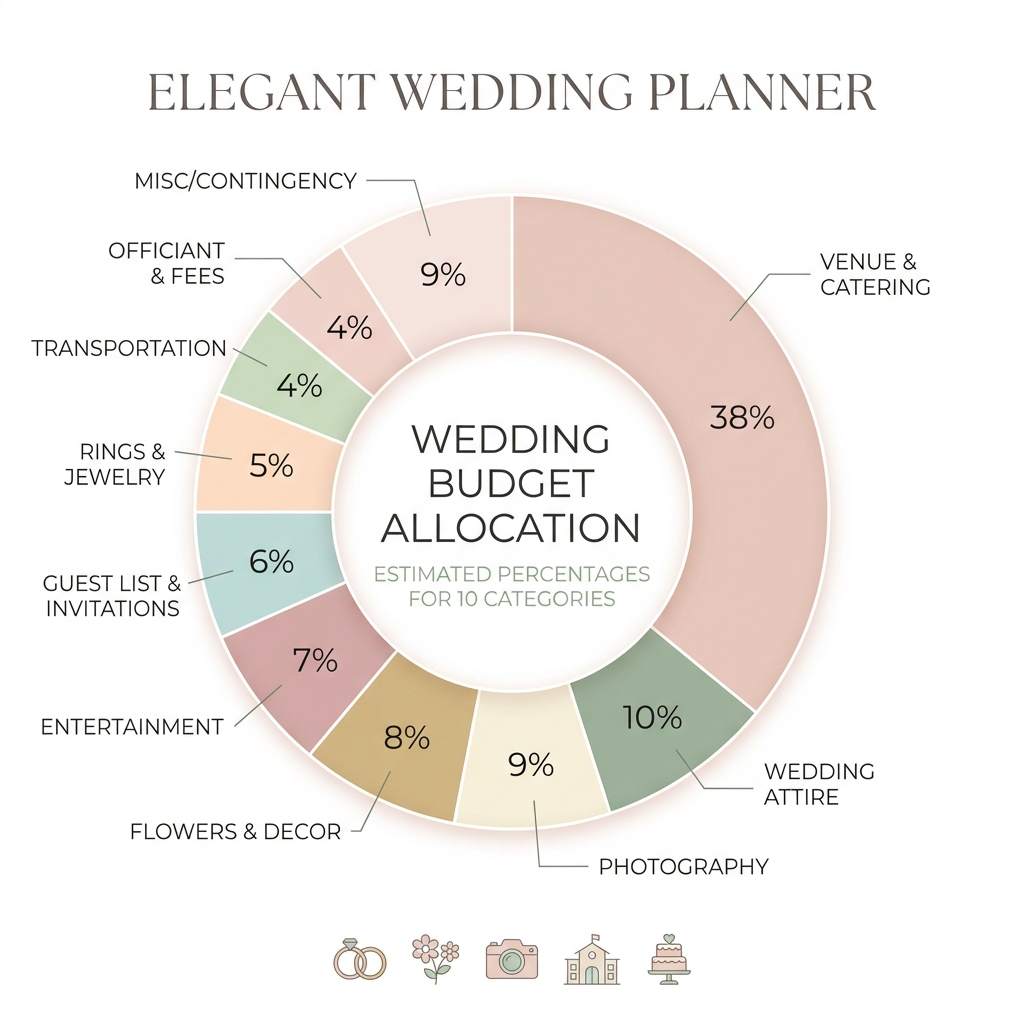
Here's how a $20,000 wedding budget checklist typically divides across the four categories that make up nearly every wedding cost.
| Category | Percentage | Dollar Amount | What's Included |
|---|---|---|---|
| Venue & Food | 45% | $9,000 | All-inclusive banquet hall, vineyard, or similar package with tables, chairs, and basic linens |
| Photography & Entertainment | 20% | $4,000 | 6-8 hours of photography plus a DJ or small live act |
| Florals & Attire | 20% | $4,000 | Gown, suit, alterations, bouquet, and centerpieces |
| Stationery & Miscellaneous | 15% | $3,000 | Invitations, favors, officiant fee, and emergency buffer |
| Total | 100% | $20,000 | Complete 4-category framework |
Category Deep Dives
Venue & Food (45% — $9,000)
Venue and catering absorb nearly half of the total, and that's intentional — it's the one category guests interact with for the entire event. At this tier, an all-inclusive banquet space or a vineyard package that bundles the room, tables, chairs, and basic linens is usually the most efficient choice, since it avoids the hidden rental fees that catch couples off guard later.
Budget roughly $9,000 for the venue rental, plated or buffet catering for 75-100 guests, and a house beer-and-wine bar. Booking an off-peak date (a Friday evening or a Sunday brunch wedding) can free up $1,000-$2,000 to move toward photography or florals.
Photography & Entertainment (20% — $4,000)
Photography and entertainment together claim about $4,000 of the total. Six to eight hours of coverage from a professional photographer typically runs $2,000-$2,800 at this tier, which is enough for getting-ready shots, the ceremony, and several hours of the reception.
A DJ with their own sound system and lighting generally costs $800-$1,200, and is the more budget-efficient entertainment choice compared to a live band, which can easily double that cost. If videography matters to you, plan to trim 5-10% from florals or stationery to fit it in rather than treating it as a free add-on.

Florals & Attire (20% — $4,000)
Attire and florals share roughly $4,000 in a $20,000 wedding budget checklist. A designer or boutique gown with alterations typically runs $1,200-$1,800, a suit or tuxedo rental or purchase adds $400-$600, and a florist handling a bridal bouquet plus 8-10 centerpieces usually costs $1,500-$2,000.
Reusing ceremony florals as reception decor and choosing in-season blooms are the two changes that make the biggest dent in this category without changing the overall look.

Stationery & Miscellaneous (15% — $3,000)
The remaining 15%, about $3,000, covers custom invitations and save-the-dates, guest favors, the officiant's fee, marriage license, hair and makeup trials, and — critically — an emergency fund.
Couples working from a $20,000 wedding budget should treat the emergency buffer as non-negotiable rather than optional; a $500-$800 cushion inside this category absorbs the vendor price increases and last-minute rental needs that show up on almost every wedding.
How to Sequence Your $20,000 Wedding Budget Across Your Planning Timeline
Spending order matters as much as category allocation. Booking your venue and caterer first locks in 45% of your total early, which makes every later decision easier because you know exactly what's left. A workable sequence looks like this:
- 12-10 months out: Book venue, caterer, and photographer (uses roughly 65% of budget) — the Vendor Booking Checklist is useful here for tracking contracts and deposit due dates.
- 9-7 months out: Book DJ or band, florist, and order the gown or suit.
- 6-4 months out: Order invitations, finalize the bar package, book hair and makeup.
- 3-1 months out: Order favors, confirm final headcount with the caterer, release remaining emergency funds if unused.
Pairing this sequence with a 12-Month Wedding Planning Checklist or the Wedding Planning Timeline tool keeps your spending and your task list moving together, instead of booking vendors faster than you can actually pay deposits. Most venues and caterers require a deposit of 25-50% at booking, so it helps to know roughly when each deposit is due before you commit to a date — a $9,000 venue and catering package might mean a $3,000-$4,500 deposit the same month you sign the contract.

7 Ways to Stretch a $20,000 Wedding Budget Further
A $20,000 wedding budget goes noticeably further with a handful of proven adjustments:
- Choose a Friday or Sunday date instead of a Saturday: many venues discount 10-20% for off-peak days, and caterers sometimes waive minimums on weekday bookings.
- Cap the guest list at 75 rather than 100: every 10 guests removed frees up roughly $600-$800 across food and bar costs, since per-head catering and bar pricing scale directly with headcount.
- Pick an all-inclusive venue over separate ceremony and reception sites: which eliminates a second site fee, a second setup crew, and often a second insurance requirement entirely.
- Serve beer and wine instead of a full open bar: this alone can save $1,000-$1,500 for 75-100 guests, and most caterers can quote both options side by side so you can compare directly.
- Book a DJ instead of a live band for entertainment: a DJ typically covers ceremony music, cocktail hour, and reception in one flat fee, where a band often charges separately for each.
- Choose in-season, locally available flowers: and reuse ceremony arrangements at the reception rather than ordering two separate sets of florals.
- Order printed invitations from a template: rather than fully custom stationery design — the printing and paper costs are nearly identical, but the design fee disappears.
$20,000 vs. $10,000 vs. $30,000: How the Budget Shifts
The category percentages in a wedding budget checklist don't stay fixed as the total changes — they shift because some costs, like photography and the officiant fee, are close to flat regardless of budget size.
| Budget Tier | Guest Count | Venue & Food | Photo & Ent. | Florals & Attire | Stationery & Misc |
|---|---|---|---|---|---|
| $10,000 | 40-50 | 40% ($4,000) | 20% ($2,000) | 20% ($2,000) | 20% ($2,000) |
| $20,000 | 75-100 | 45% ($9,000) | 20% ($4,000) | 20% ($4,000) | 15% ($3,000) |
| $30,000 | 100-125 | 48% ($14,400) | 18% ($5,400) | 19% ($5,700) | 15% ($4,500) |
Moving from a $10,000 wedding budget to this tier roughly doubles the guest count you can comfortably host, while the venue and food share of the pie actually grows, because feeding twice as many guests costs more than the fixed costs (photography, officiant, stationery) increase.
Couples considering a $30,000 wedding budget will notice stationery and miscellaneous costs level off in dollar terms relative to guest count, since favors and invitations scale with headcount but licensing and officiant fees don't.
Final Thoughts
A $20,000 wedding budget works best when the big three — venue, food, and bar — are booked first and everything else is built around what's left. Use the category breakdown above as your starting checklist, then track every deposit and payment against it as vendors get booked.
Pair this checklist with the free Wedding Budget Calculator to model your own guest count and priorities, or map it against a full 12-month planning checklist to put your spending on a clear timeline.